Principal component analysis (PCA) is frequently used for the visualization and unsupervised clustering of mass spectrometry (MS) proteomics data. However, there is no intuitive method to handle missing values, and the intricate structure of experimental design is often neglected. A typical example is data from biological experiments with replicate structure, which displays both variations and correlations among replicates, and suffers from incomplete observations. Probabilistic principal component analysis (PPCA) recovers missing values soundly within a probabilistic framework, yet it still overlooks the replicate-wise variations.
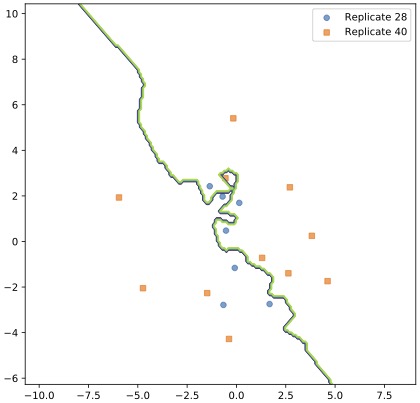
In this study, we extend PPCA to be conscious of the replicated model for MS data with replicated structures and possibly broader. We present two distinct inference approaches: one focuses on the likelihood model by the Expectation-Maximization (EM) algorithm, while the other lies in the Bayesian framework employing the Markov chain Monte Carlo (MCMC) method. Our findings indicate that both approaches yield more nuanced analyses, some aspects of which have previously been ignored by researchers. The likelihood-centric approach hints replicates that may be unsuitable for PCA and tackles the challenge of missing values. In contrast, the Bayesian approach provides insightful visualizations, quantifies clustering uncertainty, and determines the risk-minimizing clustering rule.
Report
Github
Vignettes: EM algorithm
This is a project supervised by Dr. Oliver Crook from the University of Oxford.